Radio frequency skin tightening can sound straightforward: controlled energy warms tissue to support a firmer-looking appearance without an incision. The important questions come before treatment, however. What kind of RF device is being used? Is it truly non-invasive, or does it use needles? How much laxity can it realistically address? This guide explains what Richmond-area patients should ask so a consultation leads to an informed decision rather than a promise of a surgical lift without surgery.
Call Wilmarwell at (832) 495-7404 to discuss your skin goals and request a consultation.
What is radio frequency skin tightening?
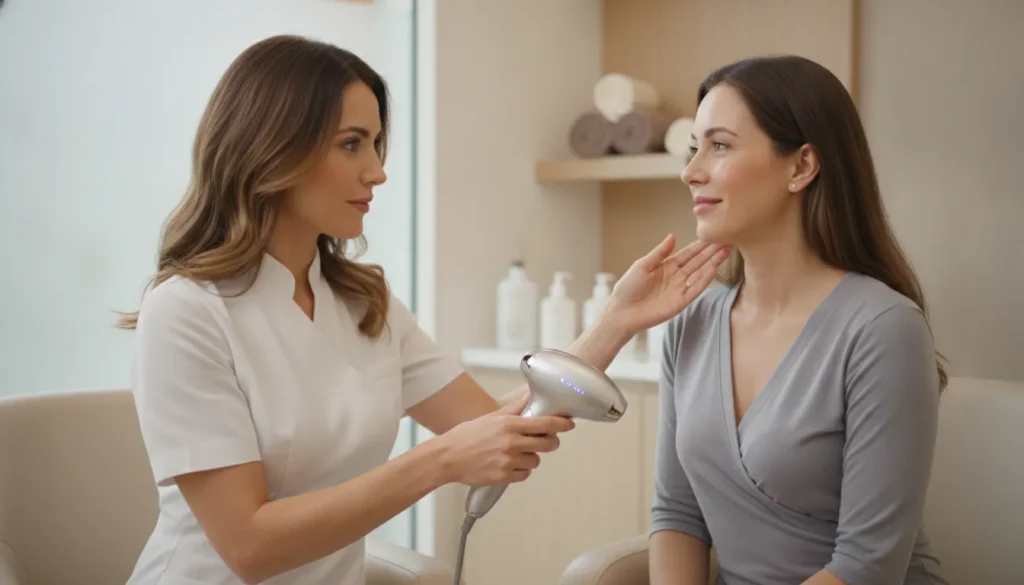
Non-invasive RF skin tightening uses an applicator placed on intact skin to deliver radiofrequency energy into tissue. The energy creates controlled heat at a selected depth. Depending on the device and treatment plan, that heat may support collagen remodeling and a gradual improvement in the look of laxity, texture, or firmness.
Radiofrequency is not one single treatment. Devices vary in energy delivery, electrode design, depth, temperature monitoring, treatment area, and approved or cleared uses. A reputable provider should explain the exact technology rather than treating the term RF as if it guarantees one predictable result. The American Academy of Dermatology’s overview of skin-firming options also emphasizes that non-invasive procedures generally produce more modest results than surgery and that improvement develops over time.
That distinction matters in Richmond, TX, where a person comparing medical spas may see non-invasive RF, RF microneedling, ultrasound, laser-based treatments, and injectables described with similar words. The name of the energy is not enough to judge the treatment. The device, technique, indication, provider, and your starting point all matter.
Non-invasive RF is not the same as RF microneedling
Non-invasive RF keeps the skin surface intact. A provider uses an external applicator to deliver energy through the skin. There are no needles entering the skin, although the experience can still include warmth, pressure, or temporary redness.
RF microneedling combines controlled needle penetration with radiofrequency energy delivered through or near the needle tips. It is a different treatment category with different depth, recovery, risks, and candidacy questions. It may be discussed for concerns such as acne scarring, texture, or more noticeable laxity, but it should not be presented as interchangeable with an external RF treatment.
Wilmarwell’s current service information confirms MDPEN Ultra microneedling, and the site also has a comparison of RF microneedling and traditional microneedling. Those resources are relevant if a consultation identifies a microneedling option, but they do not establish that Wilmarwell offers a separate non-invasive RF device. Ask the practice to confirm the current device and service before treating this article as a recommendation for a specific procedure.
Who may be a candidate?
Non-invasive RF is generally considered by people with early or moderate-looking laxity who want gradual improvement with little or no downtime. It may be discussed for areas such as the face, jawline, neck, or body, depending on the device’s design and cleared uses. It is usually a better match for someone seeking a subtle firming effect than for someone expecting a dramatic lift.
Candidacy cannot be determined by a keyword, photograph, or online checklist. During an evaluation, the provider should consider skin quality, the amount and location of laxity, prior procedures, medications, sensitivity to heat, realistic goals, and whether another option would better address the concern.
Some circumstances can require postponement, added screening, or a different treatment. These may include an active skin infection or wound in the treatment area, reduced ability to feel heat, certain implanted electronic devices or metal near the treatment area, and other device-specific contraindications. Pregnancy, recent procedures, and medications can also affect timing. The provider should review the exact manufacturer’s safety guidance and your medical history rather than offering a generic yes or no.
What results can you realistically expect?
RF can support gradual changes, but it is not a replacement for a facelift or another operation that removes or repositions excess skin. The likely result depends on the treatment area, device settings, tissue response, number of sessions, age-related changes, sun exposure, and ongoing skin care. A responsible consultation should discuss the range of possible outcomes, including the possibility that improvement will be subtle.
Some people notice a temporary feeling of tightness soon after treatment. That early sensation should not be confused with the final result. Collagen remodeling takes time, and the visible change may develop over weeks or months. A provider may recommend a series or maintenance treatments, but the schedule should be based on the device, the area treated, and your response. It should not be presented as a universal number.
Results are also not necessarily permanent. Skin continues to age, and the structural changes that caused laxity do not stop. Ask how long results typically last for the specific device and area, what maintenance means, and what evidence supports those expectations. Be cautious of guarantees, edited before-and-after photos, or claims that promise a surgical-level lift from a single session.
Questions to ask before booking treatment
A focused consultation should leave you with clear answers, not just a brand name. Consider asking:
- Which exact device will be used? Ask for the device name, the energy type, and the treatment area for which it is intended.
- Is this treatment non-invasive? Confirm whether the applicator stays on the skin or whether needles, probes, or an incision are involved.
- What result is realistic for my degree of laxity? Ask whether the goal is modest firming, texture improvement, contour support, or something else.
- How many sessions might I need? Ask for a range and what would change the recommendation, rather than accepting a fixed package without an evaluation.
- When should I judge the result? Clarify what may be temporary immediately afterward and when a longer-term change would reasonably be assessed.
- What will I feel during treatment? Ask about warmth, pressure, discomfort, cooling, and whether numbing is expected.
- What are the common and uncommon risks? The provider should explain redness, swelling, tenderness, burns, pigment changes, contour irregularity, and other risks relevant to the device and your skin.
- How is skin temperature controlled? Ask how the provider monitors heat and what happens if the treatment feels too hot.
- Who will perform the treatment? Confirm the person’s training, supervision, and experience with the exact device, especially if you have a deeper skin tone or a history of pigment changes.
- What alternatives fit my goals? Ask whether skin care, microneedling, RF microneedling, injectables, or a surgical consultation would be more appropriate.
Safety questions matter more than a device’s marketing name
Heat-based treatments can be safe when the device, settings, screening, and technique are appropriate, but more energy is not automatically better. Research reviews describe how RF systems differ in energy delivery and emphasize that treatment parameters and practitioner expertise affect outcomes and safety. Ask the provider to explain those details in plain language rather than relying on a broad technology label.
Ask whether the provider documents your baseline skin condition, confirms contraindications, and has a plan for protecting the skin during treatment. You should know who to contact if redness, pain, swelling, blistering, or a change in pigmentation does not improve as expected. If a provider dismisses safety questions, cannot identify the device, or pressures you to buy a package before examining you, consider that a reason to pause.
Patients with richly pigmented skin should not assume that every heat-based procedure is risk-free simply because it is not a laser. Skin type, prior pigment response, device settings, cooling, and operator experience all matter. Ask how the provider approaches your skin tone and whether a test area or conservative starting plan is appropriate.
How does recovery compare with other options?
Non-invasive RF often involves less visible recovery than treatments that puncture or remove the skin, but the experience varies by device and intensity. Temporary warmth, redness, tenderness, or swelling can occur. Your provider should give written aftercare instructions and tell you when to resume exercise, makeup, heat exposure, or active skin-care ingredients.
Do not compare recovery based on labels alone. A treatment described as non-invasive may still create significant heat, while RF microneedling intentionally creates micro-injuries and may require more aftercare. A consultation should compare the likely recovery with the benefit you want, your schedule, and your willingness to follow aftercare.
What are the alternatives?
The best option depends on whether your main concern is surface texture, fine lines, volume loss, submental fullness, or loose skin. A provider may discuss a skin-care plan, traditional microneedling, RF microneedling, injectables, body-focused treatments, or referral for a surgical opinion. These options do not have the same mechanism or outcome, so the decision should start with the concern rather than with a device trend.
For example, Wilmarwell’s MDPEN Ultra microneedling service page describes a verified microneedling service, which is distinct from non-invasive RF. You can also review Wilmarwell’s broader aesthetics and wellness service catalog before a consultation. The current catalog should be treated as the source of truth for available services; this article does not assume that every RF category is offered there.
That approach protects you from choosing a treatment solely because it has a familiar acronym. A good plan matches the treatment’s mechanism and recovery with your anatomy, health history, timeline, and desired level of change.
Call Wilmarwell at (832) 495-7404 to ask which verified treatment options may fit your goals.
Frequently asked questions
Does radio frequency skin tightening hurt?
Many people describe non-invasive RF as warmth, pressure, or a tingling sensation, but comfort depends on the device, settings, treatment area, and individual sensitivity. Ask how the provider controls heat and what you should feel during a normal session. Sharp pain or excessive heat should be reported immediately.
How long does radio frequency skin tightening last?
There is no single answer for every device or person. Improvement can be gradual and temporary as skin continues to age. Ask about the expected duration for the exact device and area, whether maintenance is typical, and what evidence supports the provider’s estimate.
Is radio frequency skin tightening the same as RF microneedling?
No. Non-invasive RF uses an external applicator on intact skin. RF microneedling uses needles plus radiofrequency energy and has different treatment settings, recovery, and risks. Confirm which procedure is being discussed before you book.
Can RF skin tightening replace a facelift?
No. Non-invasive RF may provide gradual, modest firming for selected patients, but it does not remove or surgically reposition excess skin. If laxity is significant or you want a dramatic change, ask whether a surgical consultation or another treatment is more appropriate.
What should I bring to a consultation?
Bring a list of medications, allergies, prior procedures, implanted devices, skin reactions, and your main goals. Photos showing how your skin has changed over time can help with discussion, but the provider still needs to examine you and review the device-specific safety information.